
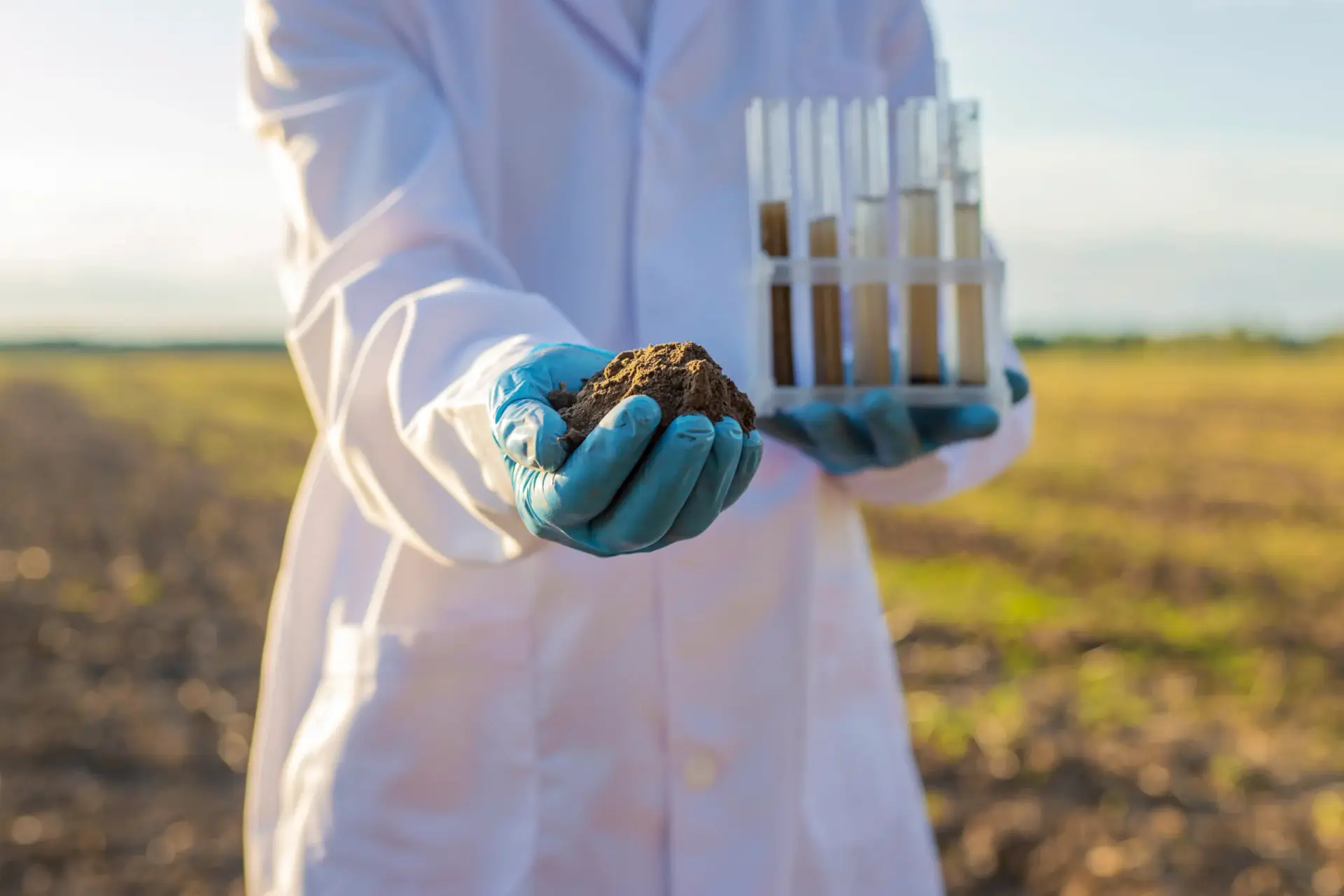
Key Analytical Capabilities for Soil & Fertilizer Assessment
Healthy soils and high-quality fertilizers form the basis for productive agriculture, sustainable land management and safe material application.
LITOLAB combines accredited laboratory methods with practical agronomic knowledge to provide a complete picture of soil fertility, nutrient availability, organic matter balance and potential contamination. Our analyses help farmers, consultants and land managers make informed decisions about fertilisation, compost use and the suitability of materials for agricultural land.
Soil Diagnostics
We examine the basic properties of agricultural soils to understand their fertility and long-term sustainability. This includes pH and buffering capacity, the availability of key nutrients (P, K, Mg, Ca, and others), mineral nitrogen content, organic matter content, and selected micronutrients.
These indicators form the basis for reliable fertilisation and liming recommendations. In addition to basic agricultural soil properties, we also determine selected contaminants such as heavy metals or persistent pollutants.
Plant nutrition diagnostics during the growing season
To reliably recommend optimal fertilisation, we determine the levels of essential nutrients and micronutrients in plant tissues. These indicators form the basis for both yield- and quality-oriented top-dressing during the growing season. Based on the laboratory results, we recommend a specific fertiliser type and its optimal application rate for the given crop and growth stage. Our recommendations reflect the current condition of the crop stand and are aimed at achieving stable yields and high product quality.
All diagnostics cover key commodities such as winter wheat, spring barley, sugar beet, maize, and other agricultural crops. Last but not least, they also include diagnostics for fruit trees and vineyards.
Fertilizer and Compost Quality
To ensure that fertilizers, composts and soil improvers meet both agronomic and legal requirements, we assess their nutrient composition, dry matter and organic matter content.
We also evaluate stability and maturity indicators and verify compliance with fertilizer and waste legislation. This helps producers, distributors and users ensure safe and effective application on agricultural land.
Substrates and Soil Amendments
Many projects involve non-standard materials such as composting feedstocks, substrates, reclaimed soils or materials intended for land application.
We characterise these materials to determine nutrient value, organic content and potential risks, supporting decisions in agriculture, remediation and site management.
Who Depends on Our Soil and Fertilizer Testing
Our analytical services support:
- Farmers and agricultural enterprises
- Agronomy advisers and consultants
- Producers and distributors of fertilizers and composts
- Municipal composting facilities and operators
- Land managers and reclamation projects
- Environmental and engineering consultancies
Typical Needs and Situations
Clients usually contact us when:
- Soils must be assessed for fertilisation or liming decisions
- Fertilizers or composts require quality verification
- Materials are being evaluated for land application compliance
- Contamination or degradation of soils is suspected
- Reclamation and greening projects require documentation
Regulatory Framework We Support
Our analyses are aligned with the relevant Czech and EU regulations, including:
Fertilizer Act (Act No. 156/1998 Coll.) – governing use and classification of fertilizers, composts and soil improvers
Decree No. 474/2000 Coll. – defining quality requirements for fertilizers and composts
Decree No. 437/2016 Coll. – criteria for use of treated sludge on agricultural land (applied analogously where required)
Waste Act (Act No. 541/2020 Coll.) & Decree No. 273/2021 Coll. – when materials are still considered waste
Our reports clearly indicate which parameters, criteria and limit values apply.
Common Applications and Planning Scenarios
LITOLAB supports real-world agricultural and environmental decision-making, such as:
Optimising fertilisation and liming based on soil nutrient status
Verifying fertilizer or compost quality before sale or application
Confirming suitability of materials for agricultural land application
Monitoring reclaimed or degraded land
Documenting compliance for grant programmes, audits or inspections
Frequently asked questions
For most farms, a full soil analysis every 3–5 years is recommended, with additional targeted tests when problems occur or land use changes.
Yes. We analyse stability indicators, nutrient composition and contaminants to determine whether the compost meets regulatory and agronomic requirements.
Yes. Based on nutrient levels, pH and buffering capacity, we can provide practical recommendations for optimal application.
Yes. Depending on their composition, we assess whether they meet the relevant criteria for reuse under fertilizer or waste regulations.